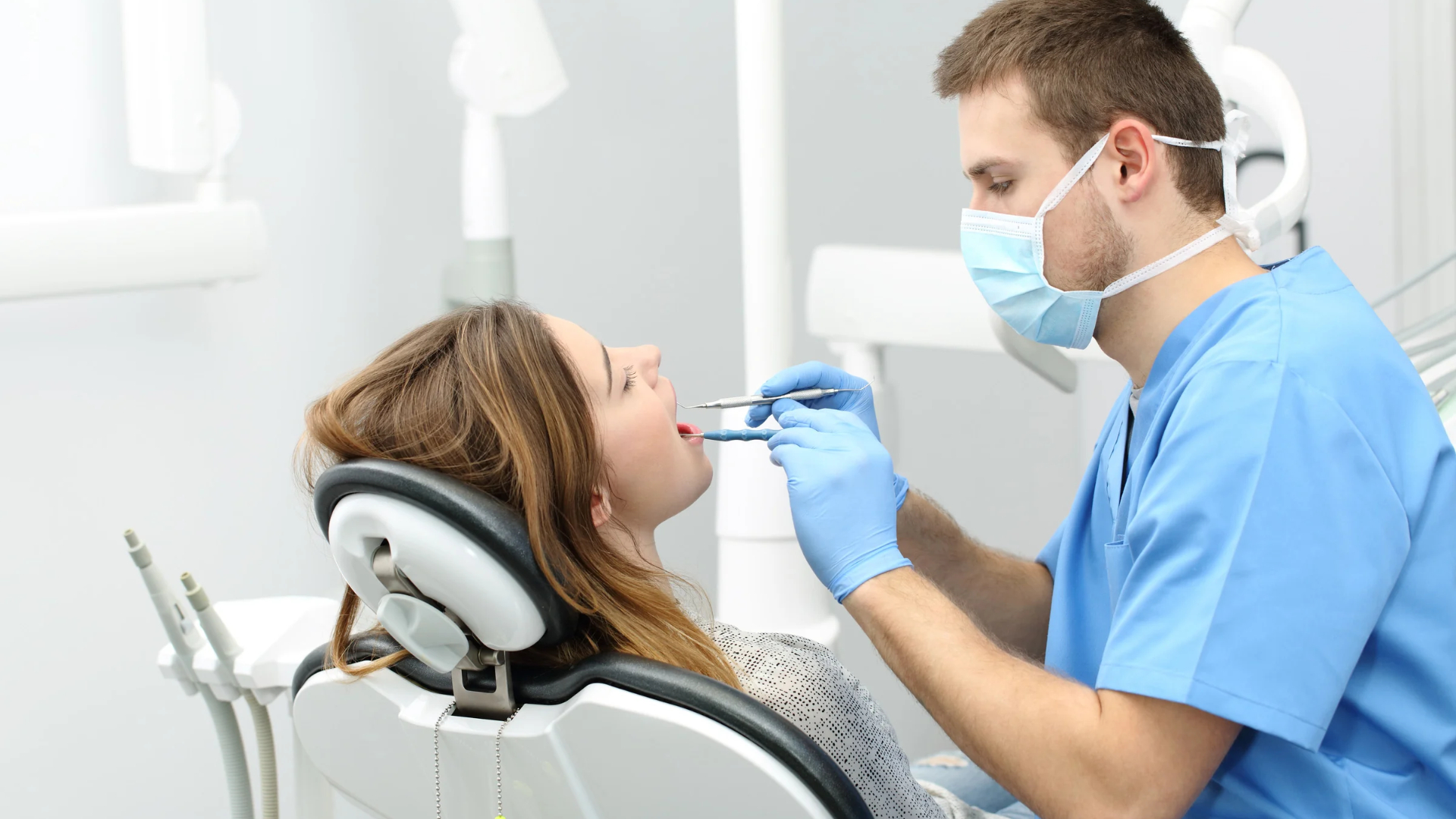
The hygienist offers you safety glasses, pulls a mask over her nose and asks you to open wide. A few minutes into the cleaning, you feel a cold fleck of water on your cheek. Look at her glasses when she leans back: some of that spray went the other way.
That’s the first reason for the mask. Your mouth has to be uncovered for treatment.
Hers is inches from the spray, and when you go home she’ll take that same seat beside the next patient. But the spots on her glasses are only the part you can see.
What was in the spray? And when it’s your turn in the chair, what happened to the air from the appointment before yours?
Why dentistry landed at No. 1 on an “unhealthiest jobs” list
There really was a ranking. In 2015, a Business Insider reporter used U.S. occupational data covering 974 jobs to compare six workplace hazards. The analysis grouped several dental occupations together, including dentists, hygienists and assistants.
That group came first. Its three biggest contributors were exposure to contaminants, contact with disease and infection, and time spent sitting.
Think about a single filling from the dentist’s side of the chair. To see the back edge of a molar, the dentist leans close while a spinning bur cuts the tooth under a stream of water.
The assistant holds suction beside it. Both have spray coming toward their faces; both may spend much of the procedure sitting in the same position. Now multiply that experience across a working week.
That repeated exposure is what makes the job unusual. The ranking didn’t count how many dentists got sick, and it tells you little about the odds of catching something at one appointment.
The CDC’s dental precautions call for mouth, nose and eye protection when splashes or sprays of blood or other body fluids are likely. Staff take those precautions with every patient; they don’t need to suspect an infection first.
A surgical mask helps intercept splashes. It doesn’t seal to the face like a fitted respirator, and neither one removes particles from the air the patient breathes.
What comes off a tooth besides water?
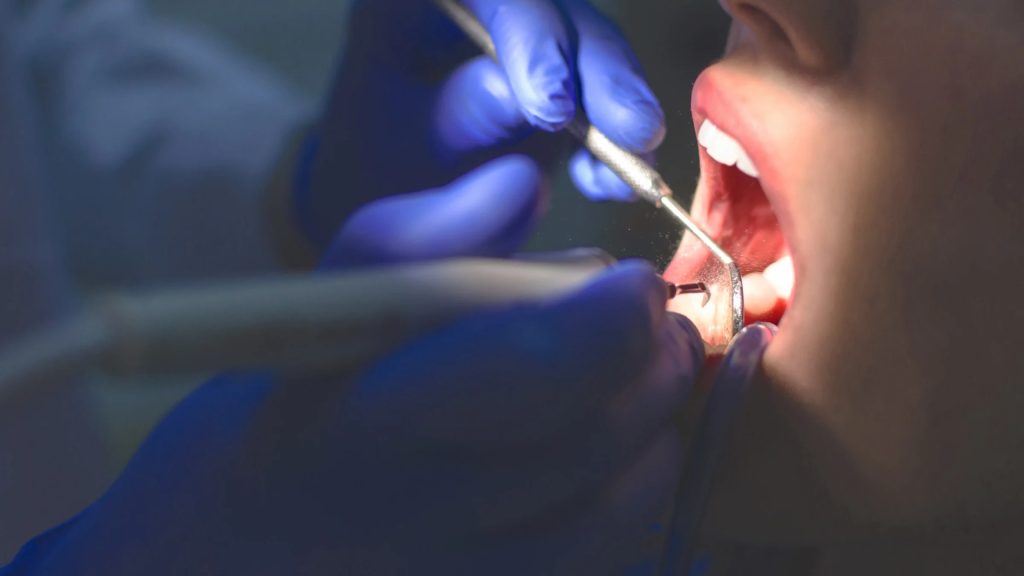
The answer changes with the tool. During an ultrasonic cleaning, the vibrating tip breaks up tartar at the gumline while water runs over it.
That spray can pick up saliva, bits of plaque and, if the gums bleed, traces of blood. When a dentist drills out an old filling, the mix can also contain fine fragments of tooth and the material being removed.
An ordinary exam with a mirror doesn’t produce the same plume. A review in the Journal of the American Dental Association describes how the instrument and the work being done shape what leaves the mouth.
The larger drops tend to land nearby: on the bib, the light handle or someone’s face shield. Finer droplets and particles can stay suspended and move with the room air.
These are the dental aerosols people worry about. Some may carry microbes, but it’s a mistake to picture the whole cloud as someone else’s saliva.
Researchers at Ohio State tested that assumption by tracing microbes collected during treatment of 28 patients. With high-volume suction in use, a median of 78% of the microbial material they traced in the collected spray came from the fluid supplied to the instrument. Detectable bacteria from saliva turned up in samples from just eight procedures.
That 78% describes the source of microbes in those samples, not the proportion of water in every droplet. The useful finding is simpler: what the instrument puts into the mouth matters alongside what it knocks loose.
The last patient leaves. What actually gets cleaned?
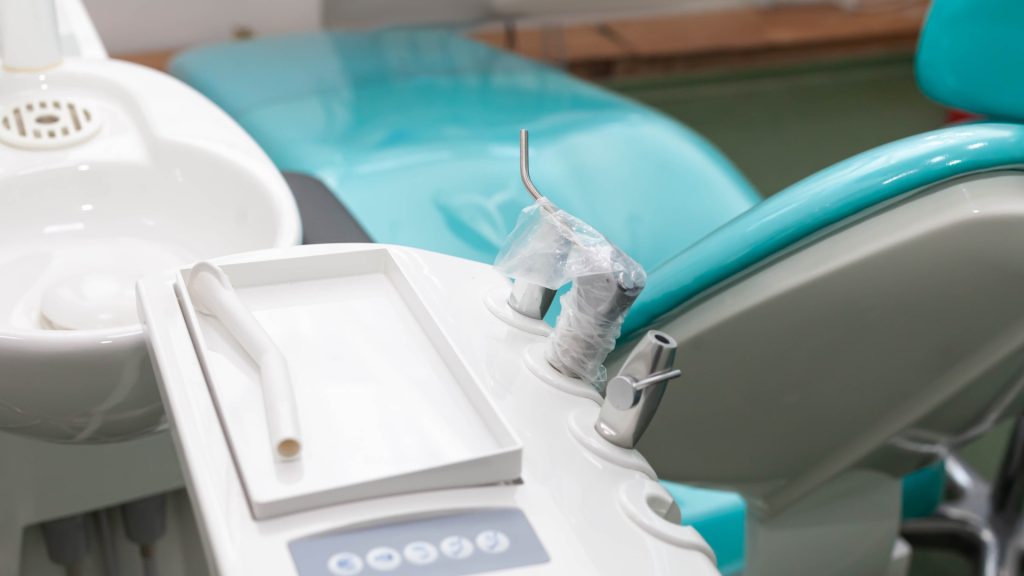
Watch the overhead light. The dentist moves it with a gloved hand, sometimes several times in one visit. Even if the handle looks spotless, that glove may just have been in someone’s mouth.
Under CDC guidance for dental practices, the team should replace a disposable barrier on that handle between patients, or clean and disinfect the exposed handle.
The same principle applies to the switches and tray surfaces the team touches. Reusable dental handpieces take a different route: they should be cleaned and heat-sterilized between patients. A disinfectant wipe on the outside can’t reach the inside of a drill.
So what do they do to the air? There may be no separate step you can watch. Suction removes some spray during treatment. A ventilation system can carry room air out and bring outdoor air in while the team works and while the room is empty.
A portable filter can keep collecting particles through both appointments. If airflow is poor, fine particles can linger after the barriers have been changed and the next tray is ready.
A strong smell of disinfectant tells you nothing about how fast the air cleared. Neither does the absence of a purifier by the chair: the building itself may be doing much of that work.
Could the previous patient’s drilling still be in the air?
Yes, fine particles can remain. The often-repeated figure of 95 minutes comes from an experiment in one dental office. Researchers ran a high-speed drill on a pig jaw. In their worst-case setup, with the door closed and no active air cleaning, it took about 95 minutes for the concentration of half-micron particles to fall back to its starting level.
That was a particle counter reading after simulated drilling. It wasn’t a finding that a previous patient’s germs remained infectious for 95 minutes.
A second experiment shows why a stopwatch is a poor guide. Researchers measured ventilation in ten dental treatment rooms and found rates ranging from 3 to 45 air changes per hour.
They used incense so they could release comparable particles in each room. In the slower rooms, ventilation alone hadn’t cleared all the added particles after half an hour.
Adding a portable HEPA cleaner helped most where ventilation was weakest. Two patients could wait the same number of minutes outside different rooms and walk back into quite different air.
What protects the person who can’t wear a mask?
The big suction tip the assistant keeps moving beside the drill is one answer. The small tube resting in the corner of your mouth drains pooled saliva.
High-volume suction, held close to the working tooth, can capture spray before it reaches anyone’s breathing space. For some procedures, a rubber dam also isolates the tooth from much of the saliva in the rest of the mouth.
For particles that escape, the practice has to consider the whole room. Outdoor-air ventilation dilutes what’s airborne; a portable purifier recirculates room air through a filter.
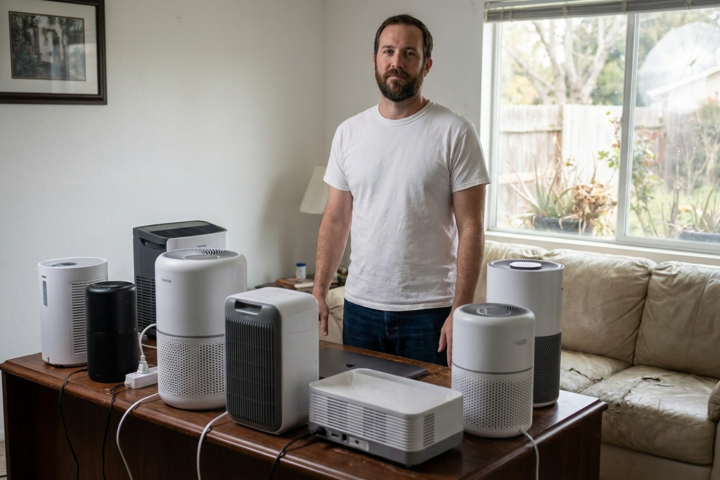
The AirDoctor 3500 and Jaspr Air Scrubber are two examples of that second approach.
AirDoctor 3500
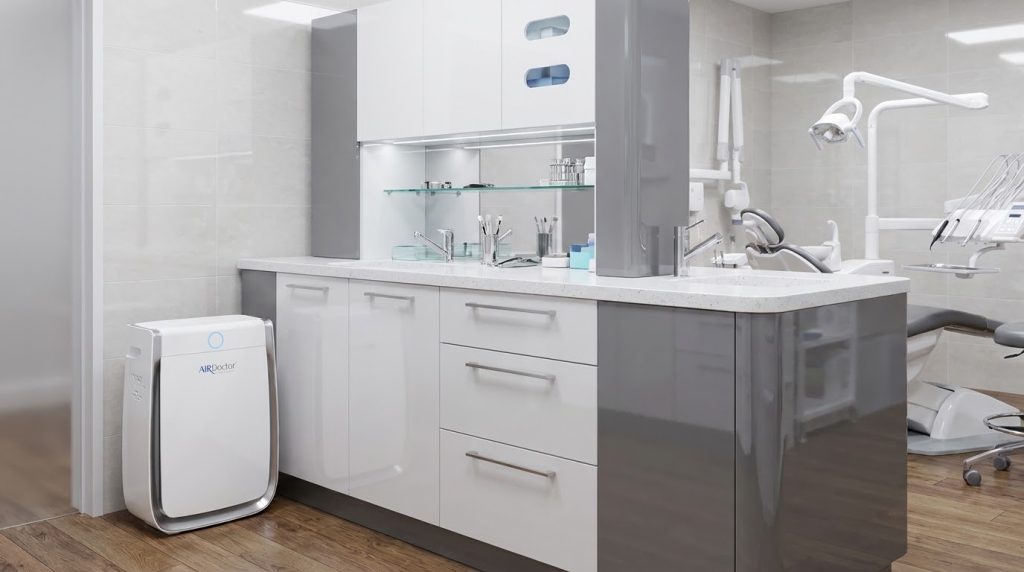
The AirDoctor 3500 draws air through a prefilter, an UltraHEPA particle filter and a carbon filter. For the fine droplets and bits of debris left by dental work, the particle filter is the part that matters.
AirDoctor lists a smoke clean air delivery rate of 340 cubic feet per minute. Smoke is the test material: the figure tells you how quickly the whole machine removes fine particles under test conditions.
It’s more useful here than a filter-efficiency percentage alone, because even an efficient filter can only capture the air that reaches it.
Jaspr Air Scrubber
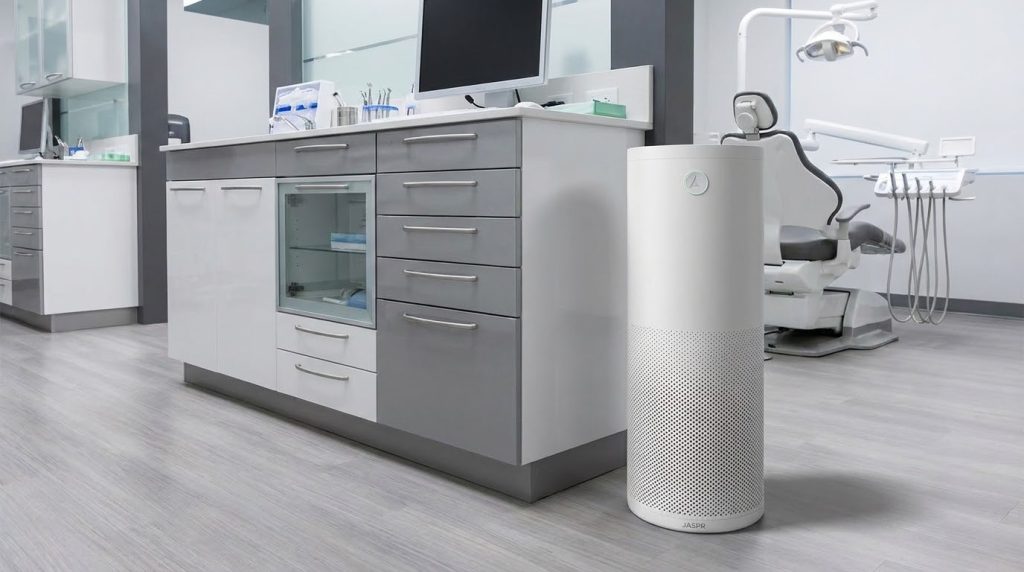
The Jaspr Air Scrubber combines particle filtration with activated carbon and has the same published maximum smoke rating: 340 cubic feet per minute.
Jaspr also gives a figure for its lowest fan setting: 114 cubic feet per minute. That difference matters in a dental office.
If staff turn the fan down so a patient can hear the dentist explain an X-ray, the unit keeps filtering, but it won’t clear particles as quickly as its headline rating suggests.
For a dental office, the useful question is how much clean air a unit delivers at the speed staff actually run it, in the room where treatment takes place. A unit beside reception says very little about the air upstairs at chair three.
If you’re curious at your next visit, ask while the chair is still upright: “When you use the drill or the ultrasonic cleaner in this room, how do you catch the spray, and what clears the air before the next patient?”
That gives the team a chance to point out things you might otherwise miss: the suction tip beside the tooth, an exhaust grille overhead, or a filter that keeps running after you leave. The mask is easy to spot. Those are the protections you share.