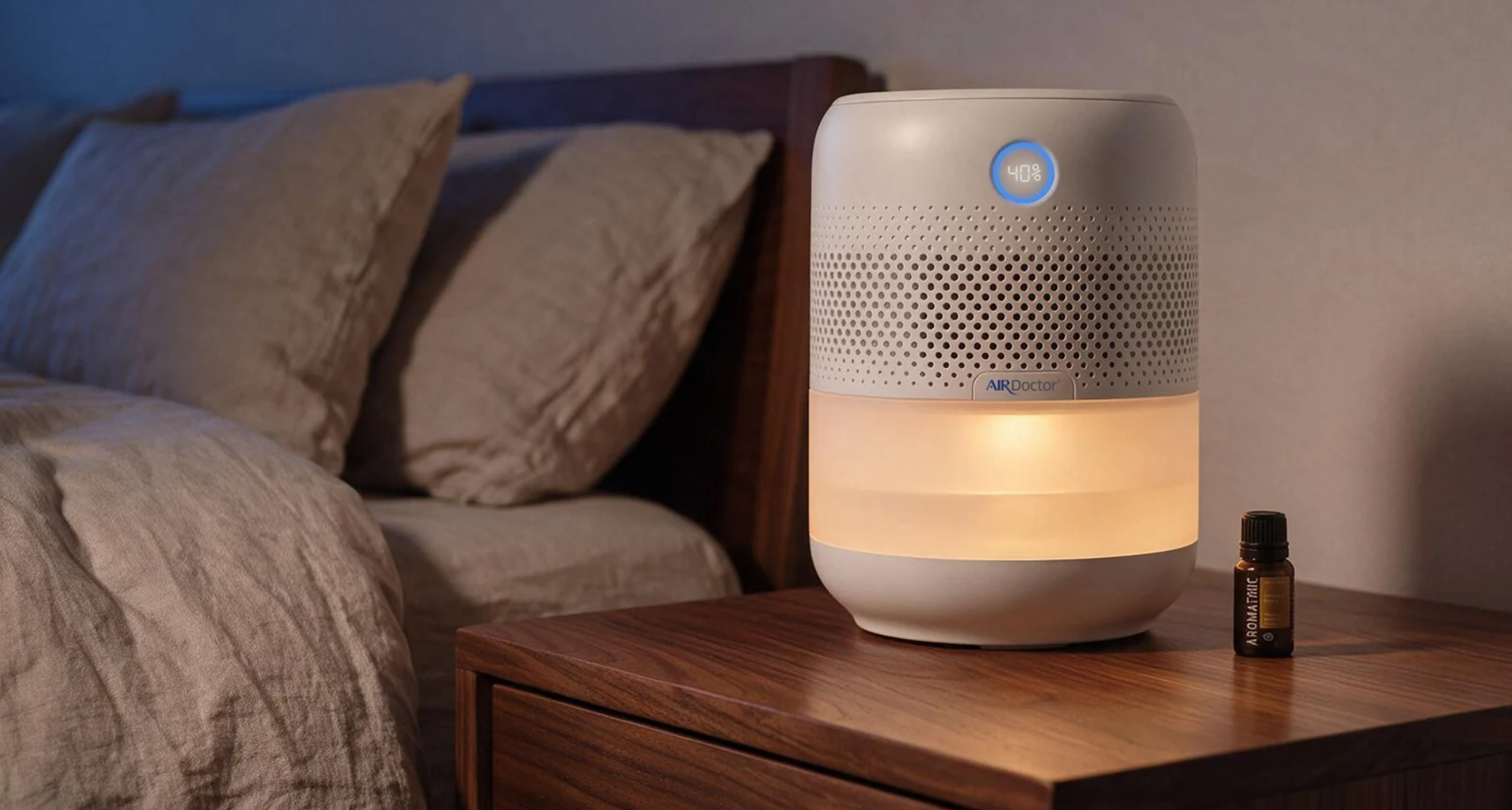
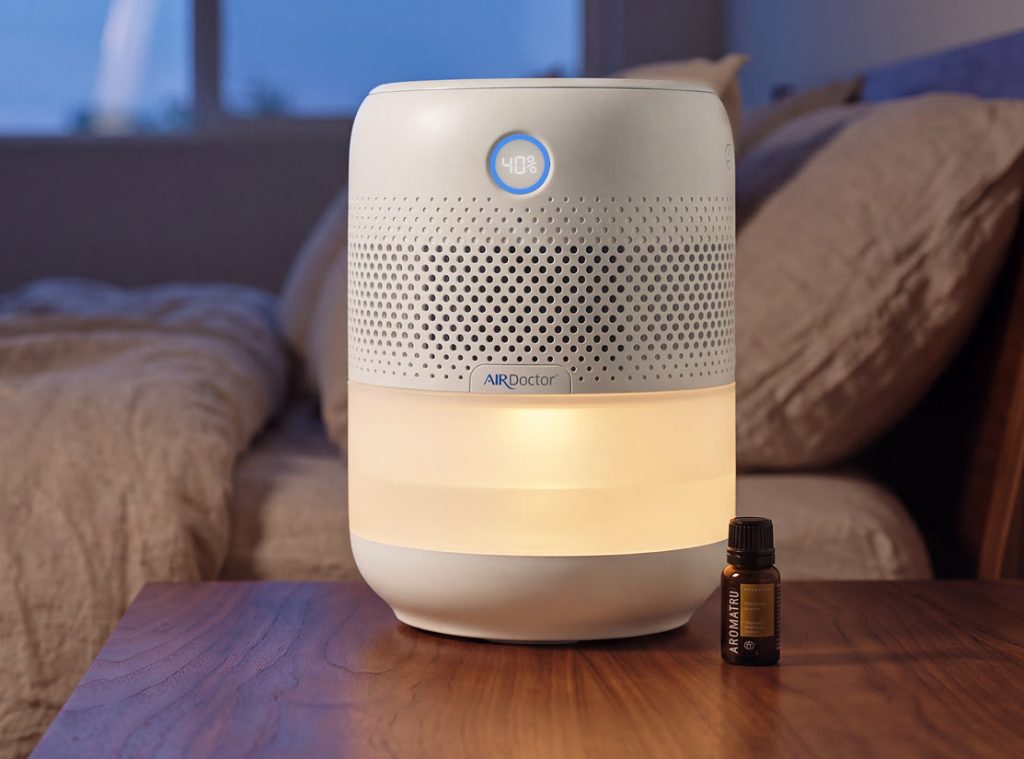
AirDoctor Humidify is AirDoctor’s new evaporative humidifier, designed to maintain comfortable indoor humidity without the visible mist or white mineral dust commonly associated with ultrasonic models.
It features automatic humidity control, a 3-liter top-fill reservoir, and an Auto Dry function designed to help keep the hydration pad dry between uses.
Let’s examine the features, maintenance requirements, and alternatives to see who should consider buying it.
Disclosure: IndoorClime may earn a commission if you purchase through links on this page, at no additional cost to you.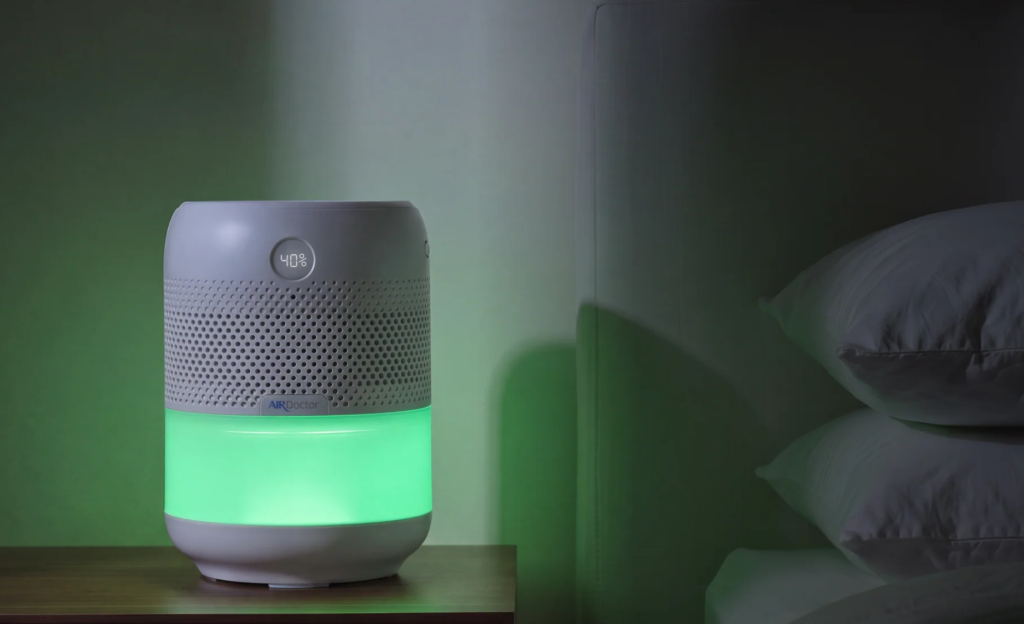
Pros
Cons
Who is AirDoctor Humidify best suited to?
I would shortlist Humidify for someone who wants to add moisture to one regularly occupied room, prefers invisible evaporation to a visible mist plume, and is willing to clean a water reservoir and replace a hydration pad.
It is particularly relevant if white dust from a tap-water ultrasonic humidifier has been frustrating you. However, a working humidifier that already maintains comfortable humidity and is easy to clean does not need replacing just because this model is new.
Measure the room’s humidity before buying. If the room is already comfortably within the 30–50% range, adding more moisture may solve nothing. A musty room or one with persistent window condensation needs investigation, not automatically another humidifier.
AirDoctor Humidify specifications at a glance
| Feature | AirDoctor Humidify |
|---|---|
| Regular price / Current offer | $179 / $139 |
| Humidification method | Evaporative; hydration pad and fan |
| Advertised room size | Up to 500 sq. ft. in the technical specifications; 536 sq. ft. elsewhere on the product page |
| Reservoir | 3.0 liters; top-fill design |
| Humidity settings | 30–50% relative humidity in 5% increments; Auto Mode targets 40% |
| Maximum runtime | Up to 48 hours before refilling; actual runtime varies |
| Size and weight | 12 inches high × 8 inches in diameter; 3.9 lb |
| Convenience features | Humidity display and Halo, Auto Dry, mood lighting, separate aromatherapy tray |
| Hydration-pad schedule | Replace every three months, according to AirDoctor |
Source: AirDoctor’s official Humidify product page. The box contains the humidifier, one hydration pad, power cord, owner’s manual, quick-start guide, and one felt pad in the aromatherapy tray.
How the evaporative design works and why white dust matters
The hydration pad absorbs water from the reservoir. A built-in fan draws air through the damp pad, allowing moisture to evaporate into the room. You should not expect to see a cloud coming out of the machine.
That is different from an ultrasonic humidifier, which creates tiny droplets. Minerals carried in those droplets can settle on nearby surfaces as white dust. With evaporation, minerals largely remain in the pad and reservoir instead.
AirDoctor says Humidify’s pad traps the minerals responsible for white dust. This is a useful reason to consider the design, but the minerals have not disappeared: cleaning and pad replacement still matter.
Humidify is a humidifier, not an AirDoctor air purifier. A hydration pad is not a substitute for the particle filters in the company’s purifiers. If you also need a separate bedroom purifier, our AirDoctor 1500 guide explains that different purchase.
Automatic humidity control is the feature I would prioritize
Auto Mode targets 40% relative humidity. You can instead choose 30%, 35%, 40%, 45%, or 50%. The display shows the sensor reading, while the blue Halo indicates that the desired level has been reached.
For a bedroom, the advantage is less manual adjustment as conditions change. You do not have to judge output by how much mist you can see. Remember, though, that the sensor measures conditions near the unit; it does not prove that every corner of the room has the same humidity.
An independent hygrometer near the area you actually occupy is a useful cross-check. Start around 40%, then adjust for the room. In cold weather, lower the setting if windows begin to collect condensation.
The EPA’s humidifier guidance advises keeping relative humidity at or below 50% and reducing use if surrounding surfaces become damp. More moisture is not automatically better.
Does it really cover 500 or 536 square feet?
AirDoctor currently uses both numbers: 500 sq. ft. in its headline specifications and 536 sq. ft. in other copy and its FAQ.
I would use 500 sq. ft. as the conservative shopping reference, rather than treating the extra 36 square feet as a meaningful advantage.
Even that figure is a manufacturer coverage claim, not a guarantee for every home. Ceiling height, open doors, ventilation, outdoor conditions, and the starting humidity change how much water a room needs.
Unlike an air purifier’s CADR calculation, square footage alone cannot tell us how quickly Humidify will raise the humidity.
| Space | Buying approach |
|---|---|
| 12 × 15 ft. bedroom: 180 sq. ft. | A reasonable single-room candidate on paper. Check humidity near the bed after setup. |
| 15 × 20 ft. office or bedroom: 300 sq. ft. | Within the advertised range; assess whether the target is maintained at an acceptable fan setting. |
| 20 × 25 ft. open space: 500 sq. ft. | At the conservative advertised limit. High ceilings or air exchange may increase the demand. |
| Two bedrooms with closed doors | Do not assume one hallway unit will control both rooms. Measure each room separately. |
The 3-liter tank and “up to 48 hours” claim
The top-fill design lets you pour water into the unit without carrying a full reservoir to the sink. AirDoctor allows clean tap, distilled, or reverse-osmosis water. Hard tap water may still mean more mineral buildup and more attention to the pad.
The 48-hour figure is a maximum, not a guaranteed refill schedule. A very dry room or a higher output setting can use water faster.
Nor does a long runtime tell you how quickly the machine can humidify a large room: the headline duration and maximum coverage should not be assumed to occur together.
Think of the runtime claim as a convenience specification, not permission to leave old water sitting in the tank for days.
Auto Dry helps with the pad; it does not replace cleaning
Humidify’s Auto Dry function dries the hydration pad after use or when the reservoir runs out of water. AirDoctor also says Sanitized® material in the vent, filter, and container helps resist mold, mildew, and bacterial growth.
Those are useful design features, but they do not make the reservoir sterile or the product maintenance-free. Follow the manual so the drying cycle can finish before storage, and do not rely on an antimicrobial material to compensate for stale water.
AirDoctor’s published routine calls for weekly washing with warm soapy water, a monthly inspection and wipe-down, and a new hydration pad every three months. Use the manual’s instructions for the individual parts; do not immerse the powered section.
EPA’s general advice is more frequent: empty, dry, and refill portable humidifiers daily, and clean them every third day. Use that more cautious routine during regular operation, with cleaning methods compatible with the manufacturer’s instructions. Auto Dry should complement that routine.
How it compares with familiar humidifiers
These alternatives cover three different priorities: smart controls, simple evaporative operation, and a smaller-room evaporative option.
| Model | Technology and controls | Tank / advertised room suitability | Main tradeoff |
|---|---|---|---|
| AirDoctor Humidify | Evaporative; 30–50% targets; Auto Dry; top fill | 3 L / up to 500 sq. ft. in technical specifications | $179 regular / $139 current offer |
| Levoit Classic 300S | Ultrasonic; Auto Mode; VeSync app; top fill | 6 L / 215–505 sq. ft. | $79.99 manufacturer price; visible mist and water-mineral considerations |
| Honeywell HCM350 | Evaporative; three manual speed settings; UV water treatment | Approximately 1 gallon / manufacturer describes medium rooms | Simple operation, but no selectable percentage humidity target; replacement wicking filter |
| Vornado EV100 | Evaporative; automatic humidity control; removable tank | 1 gallon / up to 260 sq. ft. | $69.99 manufacturer price; smaller advertised room range and replacement wick |
Room claims are not standardized side-by-side performance results. Do not rank these machines by the biggest square-foot number alone.
Levoit Classic 300S: consider it for app control
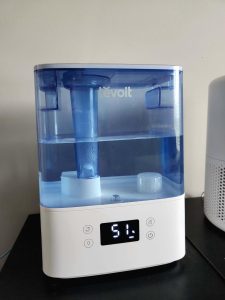
The Classic 300S offers app schedules and a larger 6-liter tank for a lower manufacturer-listed purchase price. Its advertised maximum runtime is 60 hours on low.
Choose it if those conveniences matter more to you than mist-free evaporation. With ultrasonic operation, low-mineral water is particularly relevant to avoiding white dust.
Honeywell HCM350: consider it for straightforward evaporative operation
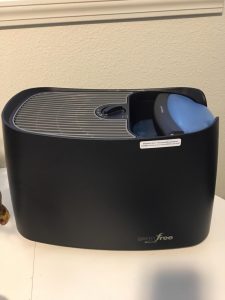
The HCM350 also releases invisible evaporated moisture. Its manual controls are simpler, but you give up Humidify’s selectable humidity target.
It uses the HAC504 Filter A; Honeywell’s evaporative support guidance gives a 30–60-day replacement interval depending on use and water quality.
Check the filter bill as well as the appliance price.
Vornado EV100: consider it for a smaller room
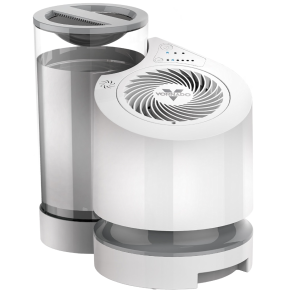
The EV100 combines evaporation with automatic humidity control. Vornado currently rates it for up to 260 sq. ft. and lists a $14.99 two-pack of replacement wicks.
At its $69.99 manufacturer price, it is a useful smaller-room comparison. A less expensive machine that fits your room can be a better buy than paying for features you will not use.
Mood lighting and aromatherapy: useful extras, not the buying reason
Humidify offers seven mood-light colors, cycling or single-color modes, and dimming. The separate aromatherapy tray accepts a felt pad for scent.
Use oils only in the designated tray as directed, rather than pouring them into the water reservoir.
I would judge these as personal preferences. A favorite light color can make the appliance more pleasant to have on a nightstand, but the color descriptions are not evidence of a medical effect.
Fragrance is optional; a bedroom humidifier does not need added scent to do its job.
Likewise, improving genuinely dry air may improve comfort, but I would not buy this product on the assumption that it boosts immunity, prevents infections, or guarantees better sleep.
Those outcomes are not established by its tank size, sensor, or Auto Dry feature.
Where to put it and what to check before ordering
AirDoctor says to use a stable, level surface at least 12 inches from walls and recommends keeping Humidify at least 6 feet from an AirDoctor purifier. Leave airflow unobstructed, protect the surface from refill spills, and keep the unit and cord out of children’s reach.
If you already run a purifier, adding a humidifier addresses a separate need. Our explanation of whether an air purifier dries out the air covers that distinction.
Before checkout, confirm the warranty and return terms for Humidify specifically. Do not assume a warranty promotion for an AirDoctor purifier also covers this new humidifier.
For light-sensitive or noise-sensitive sleepers, check the manual’s display and fan options; I have not measured its bedroom noise or tested its lights overnight.
My take: worth considering for controlled, mist-free bedroom humidity
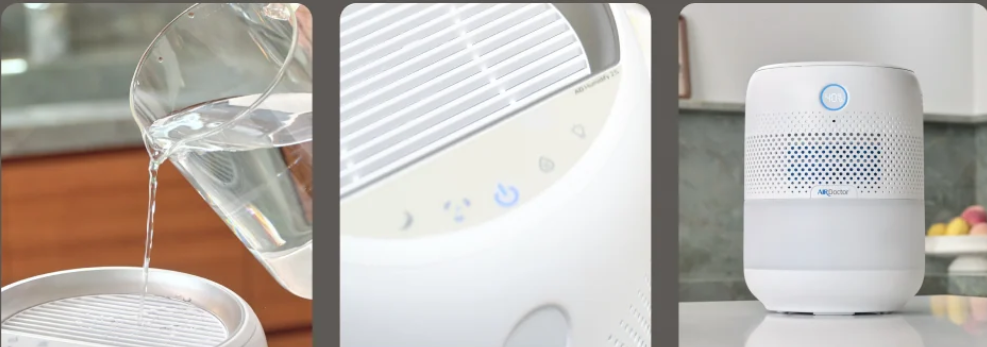
AirDoctor Humidify makes the most sense for a dry bedroom or office where you value a compact evaporative design, automatic humidity targets, and a pad-drying function.
The decision comes down to the everyday tradeoff: fewer concerns about airborne mineral dust, in exchange for a hydration pad you must maintain and replace. Confirm that ongoing cost before buying.
If your priority is app control, compare Levoit; if you want basic evaporation or a smaller-room option, compare Honeywell and Vornado.