
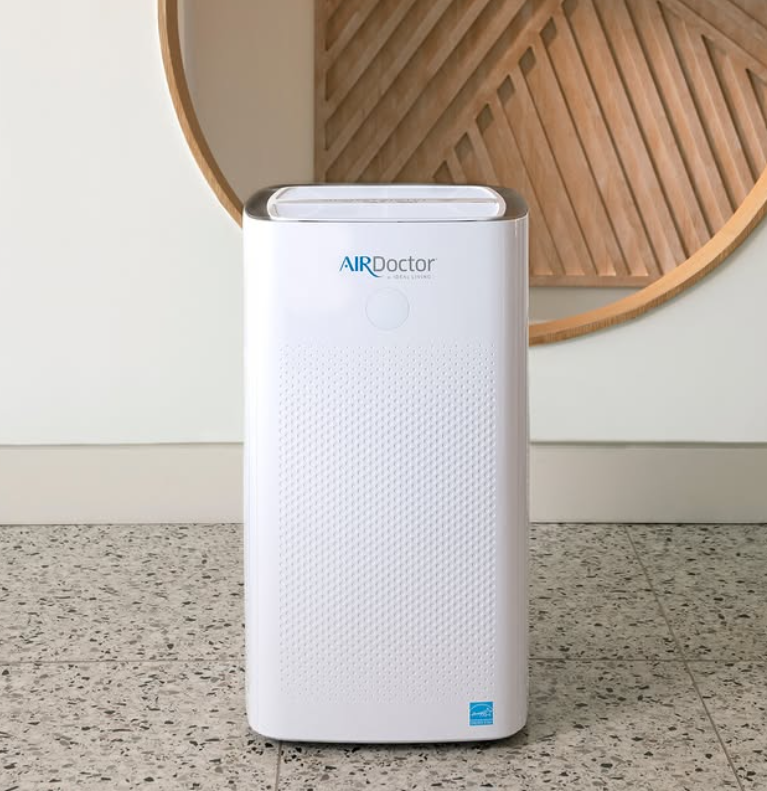
For two bedrooms with their doors closed, buy one appropriately sized purifier for each bedroom. For one large, open room, an AirDoctor 5500 can be the more practical purchase.
A bigger purifier does not automatically solve a multi-room problem.
The harder decision is a bedroom plus a living room, or an open-plan space with an awkward layout.
Below are four specific AirDoctor shopping configurations, with comparable room calculations and replacement-filter budgets.
Disclosure: IndoorClime may earn a commission if you buy through our affiliate links, at no additional cost to you. This comparison uses manufacturer specifications and calculated scenarios; it is not a measured test of these layouts. U.S. prices checked October 16, 2026.
Quick answer: which setup should you buy?
| Space you want to clean | Suggested purchase | Why it fits |
|---|---|---|
| Two separate 180 sq. ft. bedrooms | Two AirDoctor 2000s | One unit stays inside each room, including overnight with doors shut. |
| 180 sq. ft. bedroom + 400 sq. ft. living room | One AirDoctor 2000 + one 3500 | Smaller unit for the bedroom; more clean-air delivery for the living room. |
| 800 sq. ft. open-plan space, 8-foot ceiling | One AirDoctor 5500 | Enough published smoke CADR for our comparison target, with one appliance to place. |
| Same open-plan area, but spread around a bend or furniture | Consider two AirDoctor 3500s | More total rated clean-air delivery and two placement points, at a higher purchase price. |
These recommendations assume the quoted room sizes, ordinary residential use and a fan speed that delivers enough airflow.
A much larger bedroom, taller ceiling or a requirement for very quiet operation can change the choice.
Why one powerful purifier is not the same as two room purifiers
Imagine a 5500 in the hallway between two bedrooms. Its specification describes the air it can clean at the unit. It does not tell you how much bedroom air will travel through a doorway, reach that unit and return.
With doors shut, do not budget the hallway purifier as the main cleaner for either bedroom. With doors open, some air can mix, but the amount depends on the layout and airflow. You cannot reliably divide the purifier’s capacity between rooms just by adding their floor areas.
The EPA’s guide to home air cleaners describes portable purifiers as devices for a single room or area. It also advises sizing for the entire connected space in an open floor plan. Our guide to whether you need an air purifier in every room looks at how to prioritize the rooms you actually use.
Buy around the rooms occupied at the same time. Two people sleeping in different bedrooms need a different arrangement from one person moving between a home office and bedroom.
The numbers used in this comparison
To keep the comparison consistent, the calculations use published smoke CADR, measured in cubic feet per minute (CFM). This is a particle-cleaning measure, not a gas-removal rating or the fan’s raw airflow.
| Model | Purchase price | Published smoke CADR | Calculated area at 4.8 equivalent ACH* |
|---|---|---|---|
| AirDoctor 2000 | 162 CFM | 253 sq. ft. | |
| AirDoctor 3500 | 340 CFM | 531 sq. ft. | |
| AirDoctor 5500 | 556 CFM | 869 sq. ft. |
*Calculated with an 8-foot ceiling, using CADR × 60 ÷ (8 × 4.8). The 4.8 equivalent air changes per hour target is a consistent comparison benchmark, not a guarantee of a particular health outcome. Areas are rounded. Manufacturer sources: 2000, 3500 and 5500. Classic models and one-time purchases are compared; Smart versions and promotions may cost differently.
AirDoctor’s current 5500 product page lists 556 CFM, while an older support answer lists 534. We use the current product-page specification consistently here.
Even at 534 CFM, the 800 sq. ft., 8-foot-ceiling example would calculate to about 5.0 equivalent ACH, so the recommendation would not change.
Equivalent ACH describes a volume of particle-filtered air, not fresh outdoor air entering the home. These estimates also assume good mixing. Actual performance depends on placement, obstructions, filter condition and the speed you use.
The EPA notes that CADR is typically measured at the highest fan speed. Do not assume the same capacity on sleep mode. A purifier that meets the target only at maximum speed may be a poor bedroom choice if you cannot tolerate that setting.
Configuration 1: two bedrooms with closed doors
Example: two bedrooms measuring 12 × 15 feet each, with 8-foot ceilings. Each is 180 sq. ft.; both are occupied overnight.
My recommendation: two AirDoctor 2000s, one inside each room. The total purchase price is $798 at the regular price, or just $578 with our special offer. Each unit’s published CADR gives a calculated 6.75 equivalent ACH in its own example bedroom at rated output.
This is a better allocation of the budget than putting a single 5500 outside both rooms. The two smaller units cost $201 less upfront, and you can adjust each room independently. Someone who wants a quieter setting does not have to choose the other sleeper’s setting too.
Place each purifier where curtains, bedding and furniture will not block its intake or outlet, following the model’s clearance instructions. Keep cords out of walking routes. Check the sound from the pillow, not just from the doorway.
When I would choose larger units: if either bedroom is substantially larger, has a vaulted ceiling, or needs more airflow at an acceptable noise level. For example, a 300 sq. ft. room with a 10-foot ceiling needs 240 CFM to reach our 4.8 target. A 2000’s 162 CFM does not meet that calculation even at rated output.
Do not buy two identical units just for symmetry. A small guest room and a large primary suite may call for different sizes. Nor can we promise that a 3500 on a particular lower setting beats a 2000 at full speed without speed-specific CADR data.
Configuration 2: a bedroom plus a larger living room
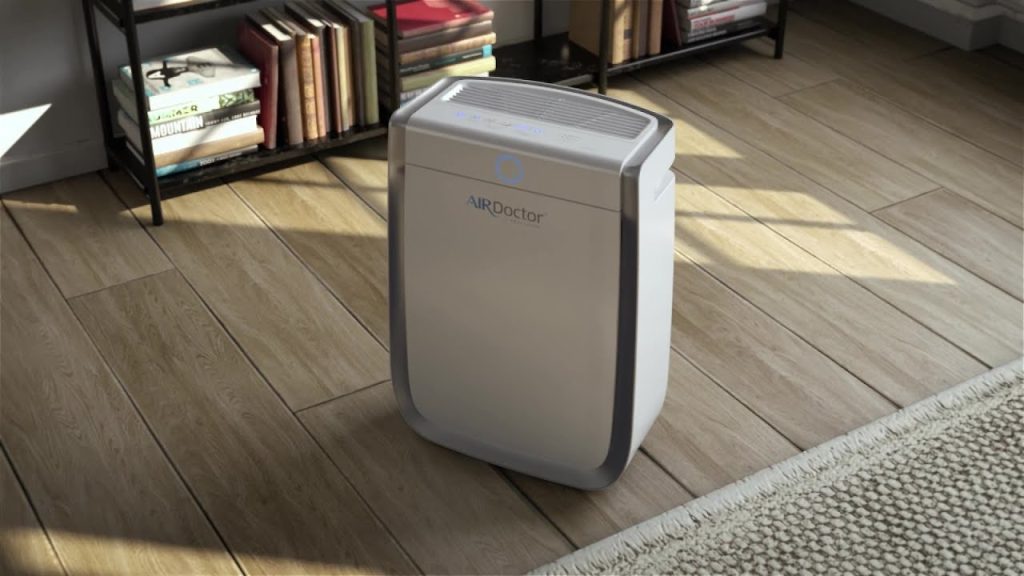
Example: a 180 sq. ft. bedroom and a separate 400 sq. ft. living room, both with 8-foot ceilings.
My recommendation: a 2000 in the bedroom and a 3500 in the living room. The combined purchase price is $1,058 at the regular price, or just $668 with our special offer.
At rated output, the calculation is 6.75 equivalent ACH in the bedroom and about 6.38 in the living room. Each room has its own cleaner; neither depends on keeping the bedroom door open.
This is where buying the biggest model can become a false economy. The 5500 is powerful, but that power does not establish a dependable air-cleaning rate in a separate occupied bedroom. The mixed pair also has a lower ongoing filter budget in the comparison below.
Two 2000s would save money, but the living-room unit would provide only about 3.04 equivalent ACH in this 400 sq. ft. example. That misses our comparison target. The sensible saving is the smaller bedroom unit, not undersizing both rooms.
If the living room opens directly into the kitchen and dining area, measure the entire connected area before choosing the 3500. A 400 sq. ft. seating area inside a much larger open plan is not a separate 400 sq. ft. room for sizing purposes.
For more detail on the product itself, see our AirDoctor review. The decision here is about distributing capacity between rooms, rather than choosing a model on filtration claims alone.
Configuration 3: one open-plan living space
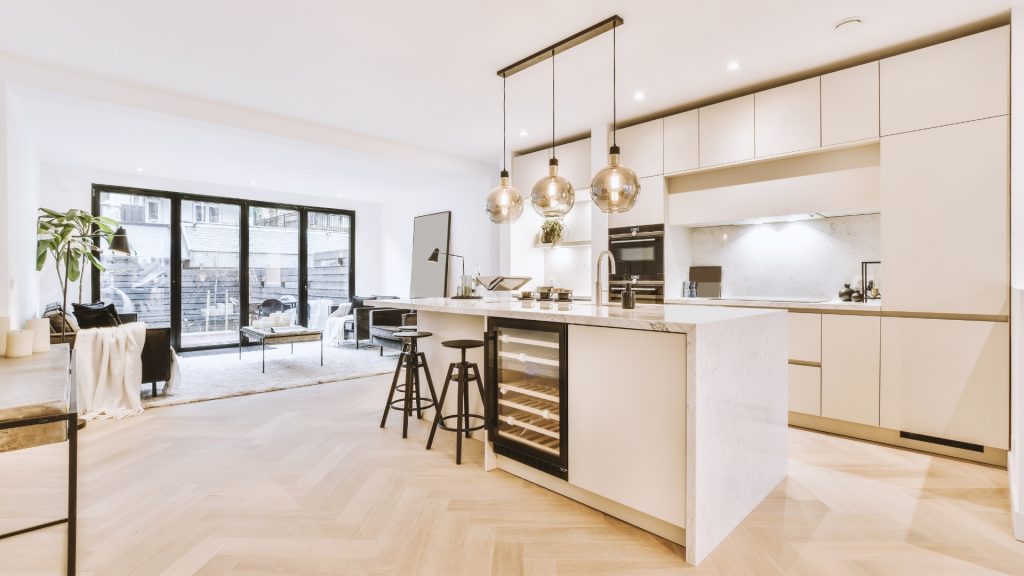
Example: an 800 sq. ft. connected living, dining and kitchen space with an 8-foot ceiling.
My starting choice: one AirDoctor 5500. Its current published smoke CADR calculates to about 5.21 equivalent ACH in that volume. It clears the 4.8 comparison target, costs less upfront than two 3500s and requires only one appliance location.
Choose a position with open airflow into the occupied space. Avoid hiding it behind a sofa or squeezing its intakes into a narrow gap. A convenient outlet does not necessarily mark the best location.
When two 3500s become worth considering: the space has two distinct occupied zones, a long shape, or a bend that makes one placement less useful. Together, they provide 680 CFM of published smoke CADR, calculating to about 6.38 equivalent ACH across this same open volume, assuming good mixing.
Distribute them between the zones rather than putting them side by side. The benefit is two cleaning locations as well as greater total rated capacity. It remains a calculated comparison, not proof that every corner will clean at the same rate.
The ceiling changes this decision. At 10 feet high, the same 800 sq. ft. space needs 640 CFM for 4.8 equivalent ACH. One 5500 calculates to 4.17; two 3500s calculate to 5.10. In that taller space, the pair makes more sense on capacity grounds.
Two 2000s are not an equivalent replacement for a 5500 in this open room. Their combined 324 CFM gives only about 3.04 equivalent ACH at an 8-foot ceiling. Two boxes can be better for two bedrooms without being stronger than one large purifier in an open plan.
For the individual model differences, our AirDoctor 3500 versus 5500 comparison provides additional context.
Purchase price and replacement-filter bills
A 5500 is one appliance, but its replacement-filter bill is not necessarily lower than the bill for two smaller units.
| Configuration | Purchase | Ongoing annual filter budget* |
|---|---|---|
| One 5500 | $354.99 | |
| Two 2000s | $253.98 | |
| One 2000 + one 3500 | $298.98 | |
| Two 3500s | $343.98 |
*Uses one annual combo pack per unit: $126.99 for the 2000, $171.99 for the 3500 and $354.99 for the 5500. These are one-time-purchase prices from the current AirDoctor filter store, without subscription discounts. Taxes, shipping and electricity are excluded. This is an ongoing budget, not an extra filter purchase required on day one.
What is included in an annual filter pack?

The 2000 and 3500 annual packs each contain one UltraHEPA filter and two carbon/VOC filters. The 5500 uses two filter sets in the machine; its annual pack supplies two UltraHEPA filters and four carbon/VOC filters. A two-pack of 5500 carbon filters therefore covers one complete carbon change, not two changes.
AirDoctor’s recommended schedule for these models is carbon replacement every six months and UltraHEPA replacement every twelve months. Actual conditions can shorten filter life. Check compatibility when ordering: the store labels 3500-compatible packs as “3000 Series” and 5500-compatible packs as “5000 Series.” Those are filter-family labels.
Subscriptions, multi-year packs and promotional prices can reduce the totals. Compare the complete delivered basket and renewal terms. A discount on the purifier alone does not tell you the future cost of maintaining it.
What about electricity?
The totals above deliberately show equipment and filters, not a claimed complete operating cost. Two units do not automatically use twice the electricity of one larger model; consumption depends on their settings and running hours.
Use measured operating watts for a useful estimate: watts ÷ 1,000 × hours per day × 365 × your electricity rate. For illustration only, an extra continuous 20 watts costs about $35.04 a year at $0.20/kWh. That is not a measured difference between these configurations.
Before buying, check these five things
- Measure each occupied space. Include ceiling height and any directly connected open area.
- Decide which doors stay closed. Give each simultaneously occupied closed bedroom its own appropriately sized cleaner.
- Choose a usable fan setting. Do not build the plan around a maximum setting you will immediately turn down.
- Mark real placement spots. Allow clear airflow and safe access to outlets, with enough room to change filters.
- Compare the complete basket. Check model version, current price, replacement packs and any recurring subscription before checkout.
If you already own a working 3500 in the living room, adding a 2000 to a modest bedroom may solve the problem more directly than replacing the 3500 with a 5500. Existing equipment should count in the purchasing plan.
My recommendation
For two modest bedrooms, choose two 2000s. For the example bedroom and living room, choose a 2000 plus a 3500. For the example 800 sq. ft. open room with an 8-foot ceiling, start with one 5500.
Move to two 3500s when the open space needs more rated capacity or benefits from two useful placement points. A taller ceiling is a concrete reason to reconsider the single-unit option.
The best purchase is the configuration that delivers enough filtered air where you spend time, at a setting you will actually use. A large coverage number on one box cannot make that decision for your floor plan.
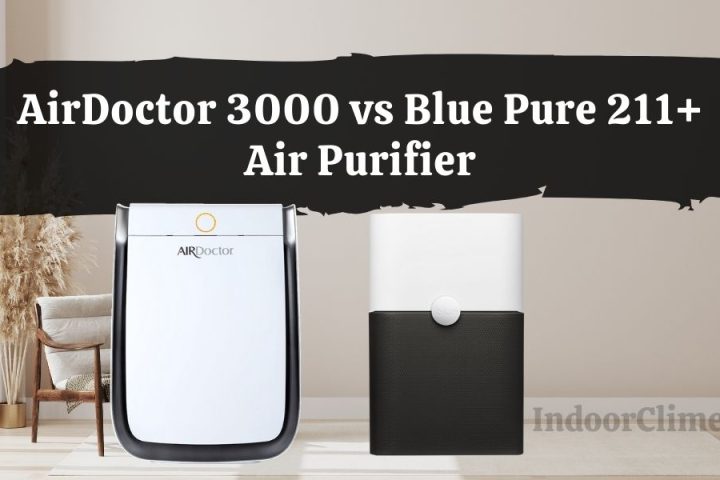
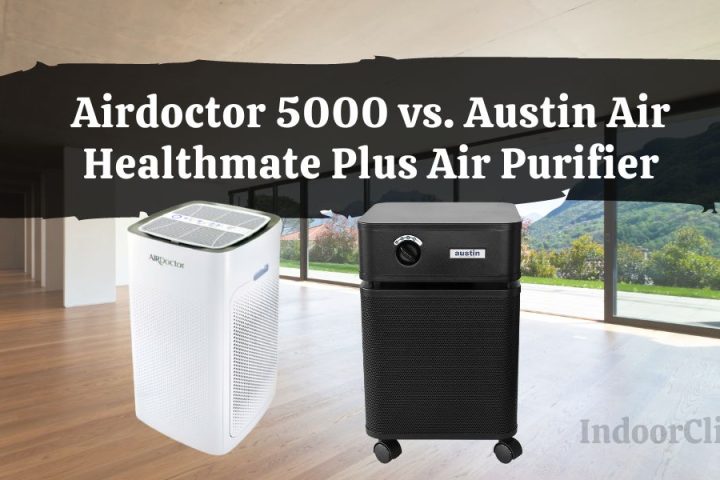


[…] Airdoctor 5500 boasts a four-stage filter for purifying and improving the air circulation of a closed room. […]